Complete Guide to Surgical Scissors: Types, Uses and Manufacturing Standards
Comprehensive guide to surgical scissors types (Mayo, Metzenbaum, Iris, Lister), medical steel grades (AISI 420/440), TC inserts, and ISO 13485 manufacturing standards.
Surgical scissors are high-precision cutting instruments manufactured for delicate tissue division, suture trimming, and medical dressing removal during surgical procedures. They differ from standard scissors in blade curvature, tip geometry, joint alignment, and medical-grade stainless steel composition.
This comprehensive technical guide details the clinical applications of Mayo, Metzenbaum, Iris, and Lister scissors, international metallurgical standards, and best practices for hospital procurement teams and distributors.
What Are Surgical Scissors?
Surgical scissors are hinged cutting instruments crafted according to international ISO 7153-1 standards. Each pattern is engineered for specific surgical disciplines: heavy scissors divide fascia and tough tissue, micro-scissors perform fine vascular dissection, and blunt-tipped patterns protect underlying structures.
Unlike general utility shears, professional surgical scissors maintain exact blade tension and razor sharpness through rigorous autoclave steam sterilization cycles.
Parts of a Surgical Scissor
Key anatomical components of surgical scissors include:
- Tips (Points): Sharp/Sharp (S/S), Sharp/Blunt (S/B), or Blunt/Blunt (B/B) configurations tailored to incision requirements.
- Blades: Straight or curved. Blade-to-shank ratio determines cutting force leverage.
- Joint (Pivot Screw): Holds blades tightly to prevent blade bypass during tissue shearing.
- Shanks: The elongated arms between joint and handles allowing deep cavity surgical access.
- Finger Rings: Gold-plated handles signify vacuum-brazed Tungsten Carbide (TC) cutting edges.
Straight vs Curved Surgical Scissors
| Specification | Straight Blades | Curved Blades |
|---|---|---|
| Primary Application | Cutting sutures, heavy threads, dressings, superficial tissue | Dissecting deep tissue inside surgical cavities |
| Visual Line of Sight | Tips sit directly in line with surgeon's hand motion | Tips remain visible above tissue cutting plane |
| Tactile Control | Linear, direct cutting force | Follows anatomical tissue contours & curves |
Blunt vs Sharp Tips
- Sharp/Sharp (S/S): Dual-pointed tips for precise micro-incision work.
- Sharp/Blunt (S/B): One sharp entry tip with one blunt protective tip.
- Blunt/Blunt (B/B): Dual rounded tips for dissecting near sensitive blood vessels.
Main Types of Surgical Scissors
1. Mayo Scissors
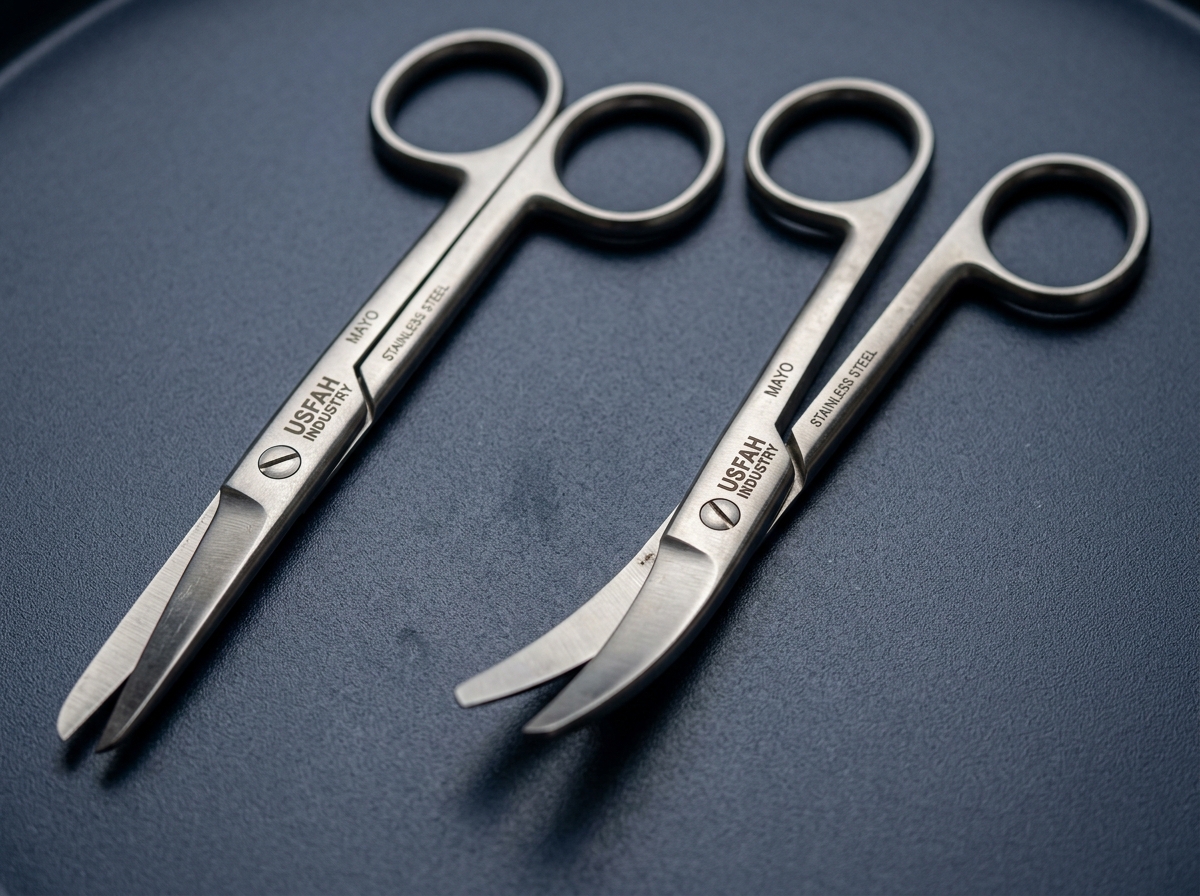
Mayo scissors are heavy-duty instruments featuring thick blades and semi-blunt tips. Straight Mayo patterns cut heavy suture materials, while curved Mayo scissors dissect dense fascia, muscle, and uterine tissue. For an in-depth clinical comparison, read our guide on Mayo vs Metzenbaum scissors.
2. Metzenbaum Scissors
Metzenbaum scissors feature long, slender shanks paired with short, fine blades. They provide exceptional tactile feedback for delicate soft tissue dissection in cardiothoracic, abdominal, and general surgery. Compare them directly with Mayo patterns in our Mayo vs Metzenbaum scissors breakdown.
3. Iris Scissors
Originally designed for ophthalmic surgery, Iris scissors are small precision tools featuring razor-sharp delicate blades. They are indispensable in plastic surgery, dermatology, and micro-vascular procedures. Similar precision engineering is also applied in specialized dental extracting forceps manufacturing.
4. Lister Bandage Scissors
Lister scissors feature an angled blade ending in a flattened safety probe tip. The probe slides safely under tight bandages, protecting patient skin during rapid dressing removal.
Materials & Steel Standards
Martensitic stainless steel grades AISI 410 and 420 heat-treated to 50 to 56 HRC Rockwell hardness form the foundation of professional surgical cutting tools. For extended durability, Tungsten Carbide (TC) inserts are vacuum-brazed to cutting edges. Full specifications are available in our official instruments catalog.
Care & Maintenance Protocol
- Rinse instruments in cold demineralized water immediately post-procedure.
- Avoid prolonged soaking in saline solutions to prevent pitting corrosion.
- Decontaminate in open position using neutral pH enzymatic cleaners.
- Apply water-soluble instrument lubricant to box joints prior to autoclaving.
Conclusion
Selecting the right surgical scissors requires matching blade geometry, tip profile, and steel grade to clinical procedures. Usfah Industry manufactures ISO 13485 certified surgical instruments for hospitals, distributors, and surgical centers worldwide.