Tenotomy Scissors: Types, Uses and Buyer Considerations
Explore tenotomy scissors, their common variations including Stevens and Westcott patterns, surgical applications, and the key considerations for buyers and medical instrument suppliers.
Tenotomy scissors are small, fine surgical scissors designed for precise cutting and delicate dissection, including work on tendons and other fine tissue. They come in several variations, and the right choice depends on the procedure, the tip style, and the build quality. This guide covers the types of tenotomy scissors, their common applications, and the points buyers and medical instrument suppliers should consider.
What Are Tenotomy Scissors?
Tenotomy scissors are lightweight scissors with slender blades, a fine pivot, and precise tips. The name comes from tenotomy, the surgical cutting of a tendon, which is one of the tasks these instruments were developed for. Today they are used more widely wherever careful, controlled cutting in small fields is needed.
Typical characteristics include:
- Slender, fine blades that allow close control.
- Light weight and good balance, which helps during detailed work.
- A smooth, precise pivot for an even cutting action.
- A compact size, commonly around 4 to 6 inches (roughly 10 to 15 cm), although this varies by manufacturer and pattern.
Types of Tenotomy Scissors
Tenotomy scissors are made in several patterns. The main differences are blade shape, tip style, and handle design.
Straight and Curved Tenotomy Scissors
Straight tenotomy scissors have blades in line with the handles and suit direct, predictable cuts in shallow, visible areas. Curved tenotomy scissors have blades that bend to one side, which improves visibility of the tips and helps when following the shape of small structures or working in deeper spaces. Straight vs curved blade geometry affects reach, visibility, and control differently depending on the procedure.
Sharp and Blunt Tips
Tenotomy scissors are offered with sharp, blunt, or combined tips. Sharp tips give the most precision in tiny areas, while blunt tips lower the chance of puncturing or catching nearby tissue and are often chosen for dissection. The trade-offs between sharp and blunt tips are worth understanding before specifying an order.
Stevens Tenotomy Scissors
Stevens tenotomy scissors are a widely recognized pattern, commonly used in ophthalmic and other fine surgical work. They are slim and lightweight, and are available in straight and curved versions with different tip styles.
Westcott Tenotomy Scissors
Westcott tenotomy scissors are another well-known pattern, typically curved and often built with a spring-action handle. The spring handle opens the blades automatically after each cut, which can reduce hand fatigue and support controlled, repeated cutting in small fields.
Other Variations
Manufacturers also produce further patterns with different blade lengths, curvatures, and handle styles. Some versions have tungsten carbide inserts in the blades, which help the cutting edge stay sharp for longer but usually cost more.
| Variation | Key feature | Typical suitability |
|---|---|---|
| Straight | Blades in line with handles | Direct cuts in shallow, visible areas |
| Curved | Blades bend to one side | Better tip visibility and contouring |
| Sharp tips | Pointed ends | Fine, precise cutting in small spaces |
| Blunt tips | Rounded ends | Dissection and work near delicate structures |
| Spring handle | Blades reopen automatically | Controlled, repeated cutting with less fatigue |
| Tungsten carbide inserts | Long-lasting edge | Frequent use where sharpness matters |
What Are Tenotomy Scissors Used For?
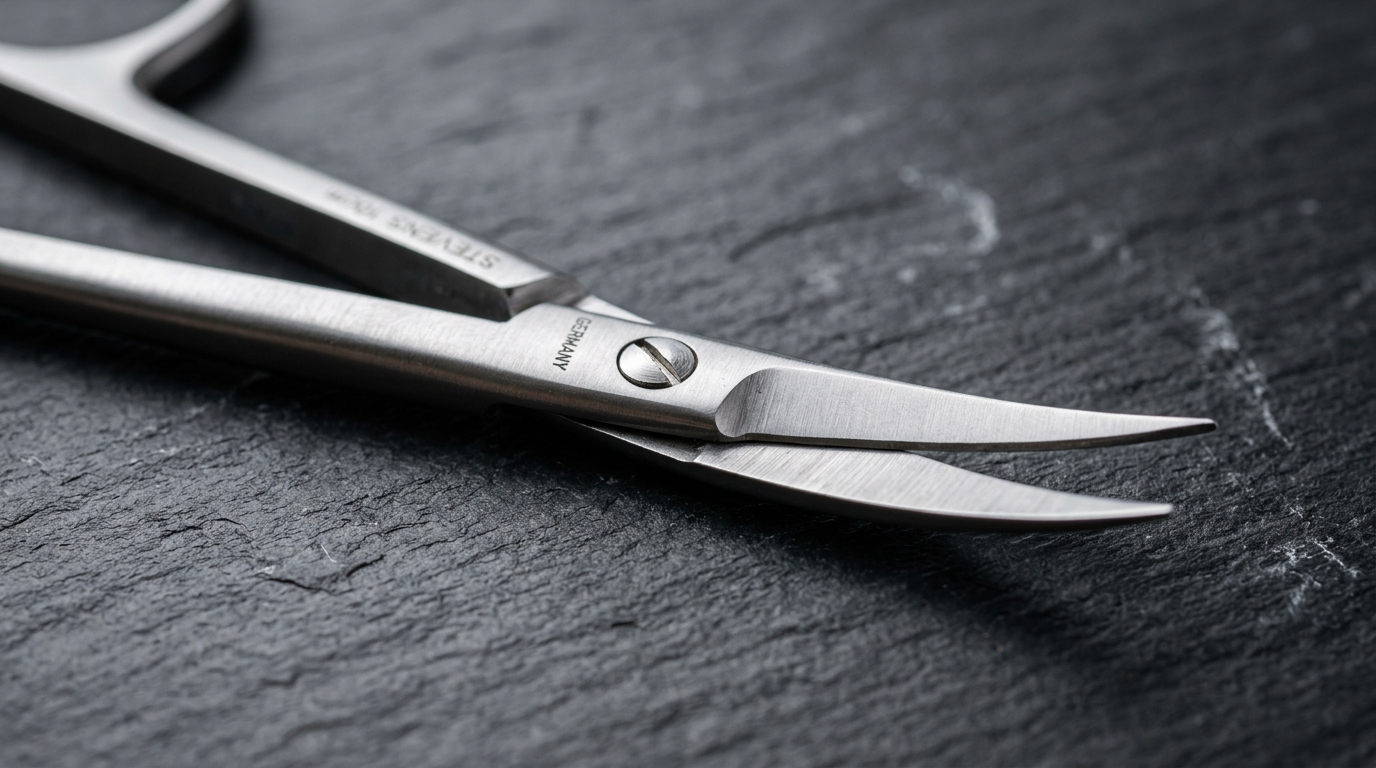
Tenotomy scissors are used for delicate, precise work. Common applications include:
- Ophthalmic surgery, such as procedures involving the small muscles and tissues around the eye.
- Orthopedic and hand surgery, for cutting and dissecting fine tendons and soft tissue.
- Plastic and reconstructive surgery, for trimming and dissecting delicate tissue.
- Podiatric procedures, where small instruments are needed for fine soft-tissue work.
- ENT and other specialties, where precise cutting in confined spaces is required.
- Laboratory and veterinary use, for small-scale dissection.
The exact instrument used in any procedure is chosen by the surgeon according to clinical needs. Tenotomy scissors are fine instruments and are not intended for heavy tissue, wire, or other hard materials, which can damage the blades.
Tenotomy Scissors vs Other Fine Surgical Scissors
- Tenotomy scissors vs Iris scissors: Both are small and fine. Iris scissors are generally shorter and often supplied with sharp tips, while tenotomy scissors come in a wider range of patterns, including blunt tips, curved blades, and spring handles.
- Tenotomy scissors vs Metzenbaum scissors: Metzenbaum scissors are longer and used for dissection at greater depth, while tenotomy scissors are suited to fine work in smaller fields.
- Tenotomy scissors vs Mayo scissors: Mayo scissors are heavy-duty and built for dense tissue, whereas tenotomy scissors are designed for delicate work.
Buyer Considerations: How to Choose Tenotomy Scissors
Whether you are equipping a clinic, hospital, or workshop, check the following before buying.
1. Pattern and Application
Start with the intended use. Different specialties favor different patterns, so confirm that the pattern you are considering suits the procedures it will be used for.
2. Blade Shape
Choose straight blades for direct cuts and curved blades for better tip visibility and contouring.
3. Tip Style
Decide between sharp, blunt, or combined tips based on the balance of precision and protection that the work requires.
4. Handle Type
Ring handles are common and familiar. Spring handles can make repeated cutting easier and reduce fatigue, but they suit specific patterns and preferences.
5. Material and Edge Quality
Surgical-grade stainless steel is standard. Tungsten carbide inserts can extend sharpness between sharpenings. Check that the blades meet cleanly along the full cutting edge, with no gaps or snagging.
6. Pivot and Action
The pivot should feel smooth and consistent, without wobble, grinding, or stiffness. A poor pivot affects control and comfort.
7. Finish and Sterilization Compatibility
A smooth, even finish makes cleaning easier. Confirm that the scissors suit the sterilization method your facility uses. Autoclave parameters and care protocols differ by instrument type and steel grade.
8. Reusable or Single-Use
Reusable scissors need to withstand repeated cleaning and sterilization and should be inspected regularly. Single-use options avoid reprocessing but have a different cost profile.
Considerations for Medical Instrument Suppliers
If you source tenotomy scissors for resale or distribution, due diligence on the manufacturer is just as important as the instrument itself. Consider asking about the following:
- Quality management system. Ask whether the manufacturer works under a recognized quality system such as ISO 13485.
- Regulatory documentation. Confirm what approvals, registrations, or declarations your target market requires, and ask for the supporting documents.
- Materials. Ask for the grade of stainless steel used and any available material documentation.
- Samples. Request samples and test them for sharpness, alignment, pivot action, finish, and feel before ordering in volume.
- Batch consistency. Ask how the manufacturer checks that each batch matches the specification.
- Specifications. Make sure length, pattern, tip style, and handle type are clearly stated and consistent in catalogues and on packaging.
- Customization. If you need private labeling, custom packaging, or particular patterns, ask what is available and what the minimum order quantities are.
- Packaging and labeling. Check that packaging protects the tips and that labeling meets your market's requirements.
- Lead times and communication. Confirm production and shipping times, and see how clearly and quickly the supplier responds.
- After-sales support. Ask how returns, replacements, and quality complaints are handled.
A dependable manufacturer will answer these questions openly and provide documentation on request. If answers are vague, treat that as a warning sign. Usfah Industry surgical scissors are manufactured to ISO 13485 standards — reach out for wholesale pricing, OEM options, and documentation.
Care and Maintenance
Fine instruments need careful handling to keep their precision:
- Clean them promptly after use so residue does not dry on the blades.
- Open the scissors fully when cleaning, including the pivot area.
- Store them so the tips are protected from knocks and from contact with heavier instruments.
- Sterilize them according to the manufacturer's instructions.
- Inspect the tips, blade edges, and pivot regularly, and have dull, bent, or misaligned scissors sharpened, repaired, or replaced.
- Use them only for the delicate work they are designed for.
Final Thoughts
Tenotomy scissors are precise, lightweight instruments with a range of patterns to suit different procedures. Understanding the differences in blade shape, tip style, and handle design helps buyers choose the right pair, and careful checks on quality, materials, and documentation help medical instrument suppliers source reliable products. Match the instrument to the task, test samples before committing, and keep the scissors well maintained to protect their precision over time. Usfah Industry manufactures ISO 13485 certified surgical instruments for hospitals, distributors, and surgical centres worldwide — get in touch for enquiries.
Frequently Asked Questions
What are tenotomy scissors used for?
They are used for precise cutting and delicate dissection of fine tissue, including tendons, in fields such as ophthalmic, orthopedic, plastic, and podiatric surgery.
What is the difference between Stevens and Westcott tenotomy scissors?
Both are well-known patterns. Stevens scissors are slim and available in straight and curved versions, while Westcott scissors are typically curved and often have a spring-action handle.
Are tenotomy scissors sharp or blunt?
Both options exist. Some have sharp tips for fine precision, others have blunt tips for safer dissection, and some combine the two. Always check the product specification.
How long are tenotomy scissors?
Most are around 4 to 6 inches (roughly 10 to 15 cm), but lengths vary by manufacturer and pattern.
What should suppliers check when sourcing tenotomy scissors?
Suppliers should check the manufacturer's quality system, regulatory documentation, materials, sample quality, batch consistency, packaging, and minimum order quantities.
Can tenotomy scissors cut heavy tissue or wire?
No. They are designed for delicate work, and cutting heavy or hard material can damage the blades. Heavier scissors are a better choice for those tasks.