What Are Metzenbaum Scissors Used For?
Learn what these fine dissecting shears are used for, their design characteristics, straight vs curved variants, blunt dissection techniques, and key sourcing criteria.
When selecting fine dissecting tools for surgical procedures, Metzenbaum scissors stand out for their exceptional dexterity and tactile control on delicate tissue layers. If you are setting up operating room trays, reviewing surgical instrumentation, or sourcing tools for a medical facility, understanding how these refined shears function, and where they should not be applied, is essential for maintaining patient safety and preserving instrument lifespan.
In surgical specialties ranging from vascular reconstruction to plastic surgery, dividing fragile anatomical structures requires minimal trauma to surrounding capillaries and nerves. These specialized dissecting instruments were engineered specifically to meet this clinical demand. This comprehensive guide covers their mechanical design, primary surgical applications, operational limits, straight versus curved variations, and key procurement standards when evaluating suppliers of medical-grade stainless steel instruments.
Design & Anatomical Characteristics
Named after Dr. Myron Metzenbaum, a prominent American oral and maxillofacial surgeon, these fine shears were engineered specifically for soft tissue dissection and gentle anatomical separation. Unlike heavy utility shears, their mechanical geometry prioritizes tactile feedback and controlled shearing over brute cutting force.
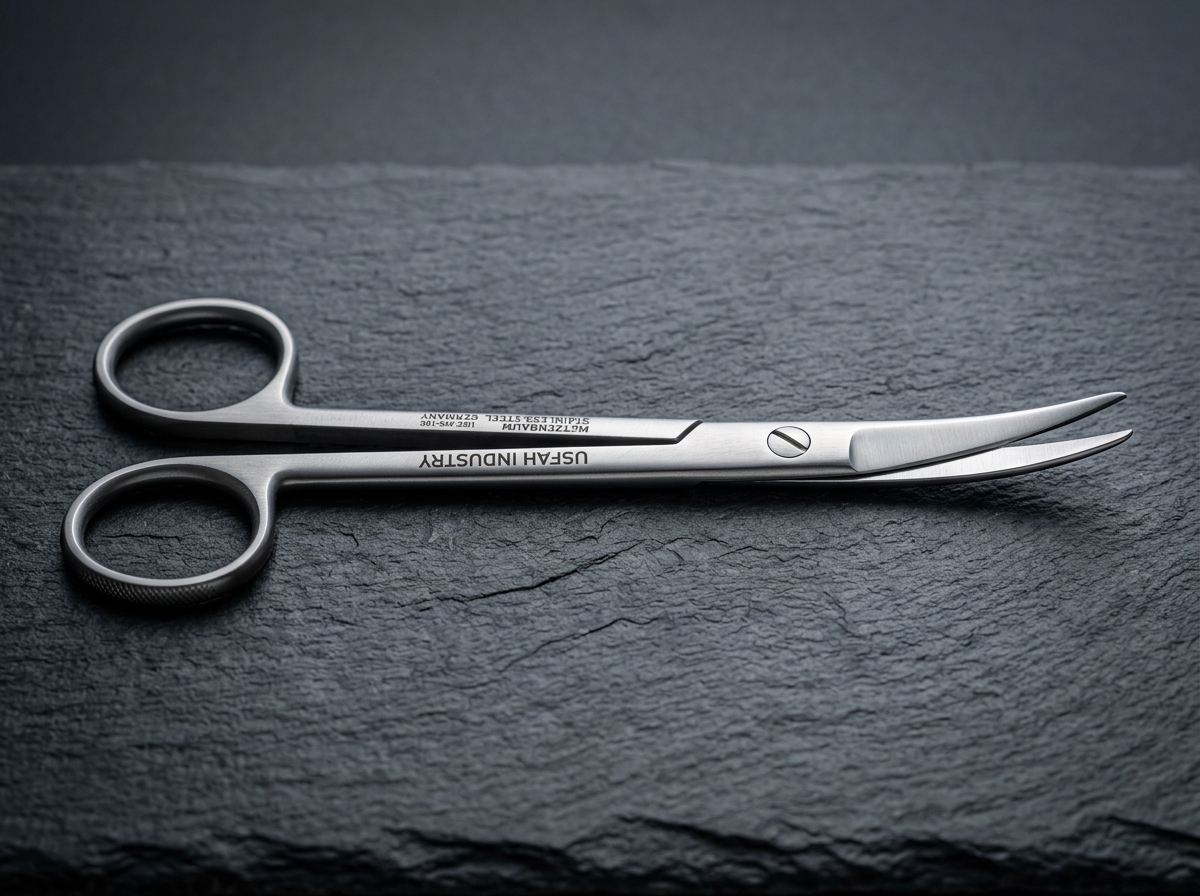
The defining feature of this pattern is its high shank to blade length ratio. Featuring long, slender shanks paired with short, thin blades, the instrument acts as a delicate mechanical lever that dampens sudden hand movements, enabling surgeons to execute precise micro adjustments deep within body cavities.
Key Anatomical & Engineering Features:
- Elongated Slender Shanks: Reach deep into abdominal, thoracic, or pelvic surgical fields while keeping the surgeon hand comfortably clear of the visual axis.
- Thin, Narrow Blades: Precision ground edges slice cleanly through delicate fascial planes without crushing adjacent capillary beds.
- High Mechanical Ratio: Long shanks relative to short working tips deliver subtle resistance feedback directly to the operator fingertips.
- Blunt Safety Points: Rounded, non traumatic tip geometry prevents accidental puncture of underlying organs, major vessels, or nerve sheaths.
- Lightweight Balance: Ergonomically balanced construction reduces hand fatigue during lengthy surgical procedures.
- Versatile Sizing: Available in straight and curved designs ranging from delicate 11.5 cm micro patterns to extended 28 cm deep cavity options.
For a broader clinical overview of cutting instruments across all surgical tray configurations, read our complete guide to surgical scissors.
What Are Metzenbaum Scissors Used For?
These refined shears are primarily used for dissecting, sectioning, and separating soft, delicate tissue where accuracy matters far more than cutting power. Surgeons rely on them whenever tissue separation requires high tactile discrimination to avoid severing hidden blood vessels or nerve branches.
1. Soft Tissue & Peritoneal Dissection
In general abdominal surgery, clinicians use these shears to isolate organs, section peritoneal attachments, and dissect mesenteric fat layers during bowel resections, cholecystectomies, and appendectomies. Their fine blades allow the operator to sense subtle tissue resistance and tease apart anatomical planes safely.
2. Vascular & Cardiovascular Procedures
During cardiac and vascular operations, surgical teams employ fine tipped curved shears to dissect arterial sheaths, mobilize saphenous vein grafts, and isolate major vessel walls without damaging delicate endothelial tissue.
3. Plastic & Reconstructive Surgery
In cosmetic and reconstructive operations, preserving skin flap viability is critical. These instruments allow surgeons to undermine skin flaps, trim subcutaneous adipose tissue, and release fibrous adhesions with minimal tissue trauma.
4. Blunt Dissection Technique
One of the most essential techniques performed with these tools is blunt dissection. Rather than cutting with open blades, the surgeon introduces the closed blunt tips into a natural tissue plane and gently opens the handles. As the tips expand inside the tissue, they separate fascial layers along natural cleavage lines without severing blood vessels or nerves.
Applications to Avoid (Contraindications)
Understanding what an instrument is not designed for is just as vital as knowing its primary uses. Misapplying fine dissecting shears to heavy materials is a major cause of premature tool damage in operating theaters.
- Cutting Synthetic Sutures or Wire: Braided synthetic sutures, such as Vicryl or Ethibond, and monofilament lines are dense. Trimming them with fine dissecting blades dulls the shearing edges and creates microscopic notches.
- Sectioning Heavy Fascia or Tendons: Thick abdominal rectus sheath fascia, cartilage, or tough tendons require strong mechanical leverage that can spring or misalign fine screw joints.
- Trimming Utility Items or Drapes: Chest tubes, suction hoses, and sterile surgical drapes should strictly be cut with heavy utility shears.
When heavy tissue or suture cutting is required, surgical staff should switch to heavy Mayo tools. For a detailed side by side technical breakdown, refer to our comprehensive Mayo vs Metzenbaum scissors comparison.
Straight vs. Curved Blade Variants
These dissecting instruments are manufactured in two main blade profiles: straight and curved. Choosing the right profile depends on surgical depth, maneuverability, and visual access needed during the case.
| Pattern | Primary Clinical Setting | Ergonomic Advantage |
|---|---|---|
| Straight Pattern | Superficial tissue dissection, surface-level wound margins, shallow surgical sites | Direct linear cutting plane aligned with hand motion |
| Curved Pattern | Deep cavity dissection (abdominal, pelvic, thoracic), retroperitoneal separation | Upward tip curvature keeps working points visible without blocking line of sight |
Curved blade configurations are overwhelmingly preferred in deep surgical cavities because the curvature allows the operator to maintain continuous visual contact with the working tips while maneuvering around critical anatomical structures.
Key Sourcing & Procurement Criteria
When hospital procurement officers, central sterile supply managers, or medical distributors evaluate suppliers of surgical shears, examining metallurgical and manufacturing benchmarks ensures long term reliability and cost efficiency.
1. Stainless Steel Hardness & Passivation
Require medical-grade martensitic stainless steel such as AISI 420 or AISI 440, vacuum heat-treated to 50 to 54 HRC Rockwell hardness. Proper chemical acid passivation removes free surface iron, creating a self healing chromium oxide barrier that resists rust during repeated steam autoclave cycles.
2. Tungsten Carbide (TC) Edge Inserts
For high-demand operating rooms, premium variants feature Tungsten Carbide (TC) inserts vacuum-brazed onto the cutting edges. Marked by gold-plated finger rings, TC-reinforced shears retain razor sharpness up to five times longer than standard stainless steel patterns.
3. Sterilization Standards & Care
Ensure the instruments withstand standard hospital decontamination routines, ultrasonic baths, and steam processing at 134°C. Reviewing established autoclave sterilization protocols helps hospital CSSD teams prevent joint stiffness and pitting corrosion.
4. Certification & OEM Manufacturing
Verify compliance with ISO 13485 quality management systems, CE marking requirements, and ISO 7153-1 material specifications. Hospital buyers can review complete sizing and pattern lists in our official instruments catalog, or contact our surgical instruments manufacturer in Sialkot, Pakistan for custom OEM export quotes.
Conclusion
Fine dissecting shears remain an essential cornerstone of operating room precision. By understanding their design advantages, applying proper blunt dissection techniques, and reserving heavy sectioning tasks for Mayo instruments, surgical teams preserve tissue integrity while maximizing tool lifespan. Usfah Industry manufactures ISO 13485 certified surgical instruments for hospital supply chains and healthcare distributors worldwide.
Frequently Asked Questions
Can these delicate dissecting shears be used to cut sutures?
It is not recommended. Their thin, fine-ground blades are specifically engineered for soft tissue separation. Trimming synthetic sutures, wire, or heavy dressings can create micro-notches on the shearing edges and ruin pivot alignment. Mayo shears should be used for suture cutting.
How do these instruments differ from Mayo patterns?
These dissecting shears feature longer, slender shanks and shorter fine blades built for delicate tissue handling. In contrast, Mayo shears feature thicker, heavier blades designed to cut tough muscle fascia, dense tendons, and sutures.
Are these tools utilized across all surgical disciplines?
Yes, they are standard across almost every operating theater tray, but are especially vital in vascular, plastic, cardiothoracic, and general abdominal procedures where fine tissue preservation is crucial.
Why are curved blade variations preferred over straight ones?
Curved blades keep the cutting tips visible above the surgeon's hand position while navigating inside deep body cavities, allowing effortless maneuvering around delicate blood vessels without blocking line of sight.
What do gold-plated handles indicate on these instruments?
Gold-plated finger rings signify vacuum-brazed Tungsten Carbide (TC) inserts along the cutting edges, which maintain razor-sharp performance up to five times longer than standard stainless steel.