Sharp vs Blunt Surgical Scissors: Understanding the Difference
Understand the difference between sharp and blunt surgical scissors and how these tip design characteristics relate to different surgical applications, from fine dissection to general cutting.
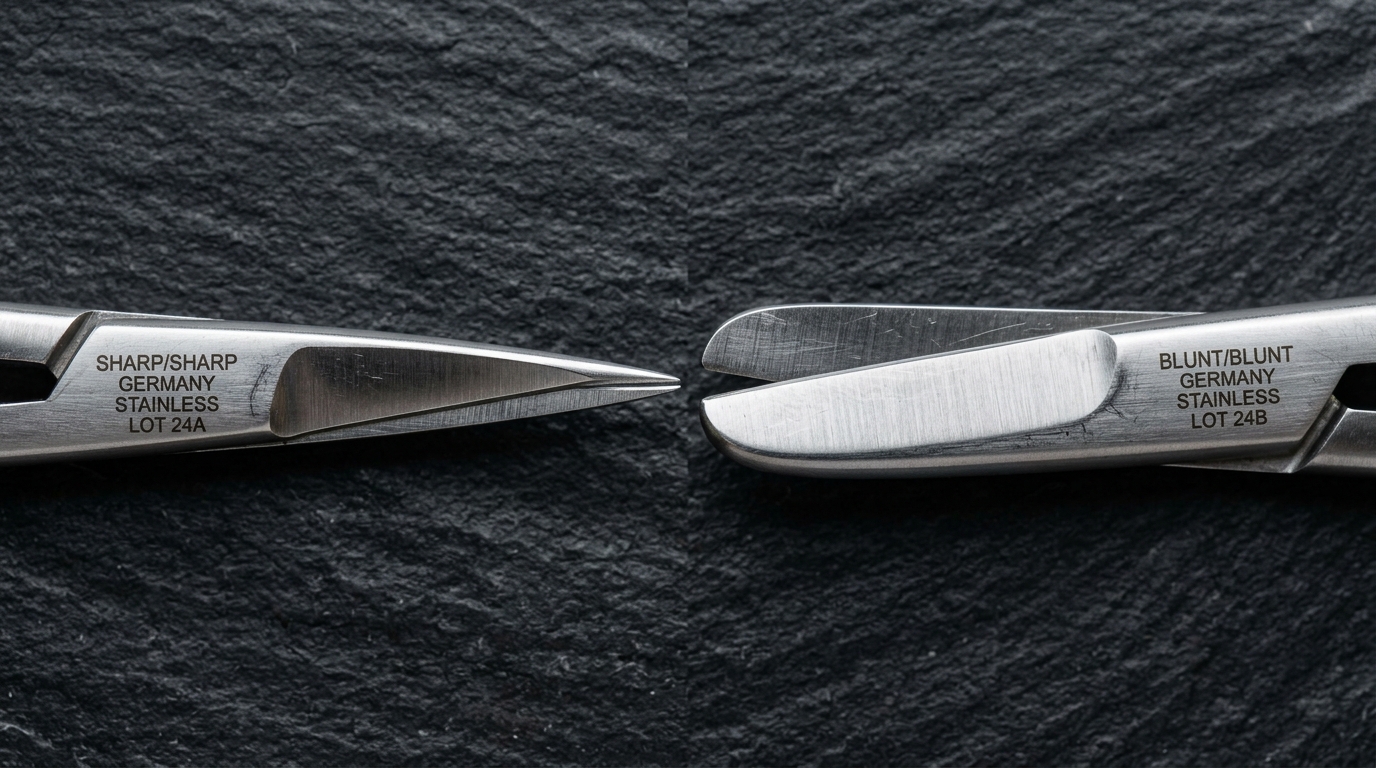
Surgical scissors are not all built the same, and one of the most important design details is the shape of the tips. Sharp vs blunt surgical scissors differ in how the tips are ground: sharp tips come to a fine point, while blunt tips are rounded. This guide explains each style, how the tip design relates to different applications, and what to consider when choosing between them.
Sharp surgical scissors have pointed tips that allow fine, precise cutting and access to small spaces. Blunt surgical scissors have rounded tips that lower the chance of puncturing or catching nearby tissue, which makes them a common choice for dissection and for work close to delicate structures. Many scissors combine the two, with one sharp tip and one blunt tip. The right choice depends on the task, the tissue, and the level of precision required. For a broader overview of all scissor types and designs, read our complete guide to surgical scissors.
What Does "Sharp" and "Blunt" Mean in Surgical Scissors?
When manufacturers describe surgical scissors as sharp or blunt, they are usually talking about the tips of the blades, not the cutting edges. Both types have cutting edges that close against each other to cut. The difference is in how the ends of the blades are shaped.
Tip styles are normally described with abbreviations:
- Sharp/sharp (S/S): both blades end in a point.
- Sharp/blunt (S/B): one blade is pointed and the other is rounded.
- Blunt/blunt (B/B): both blades have rounded tips.
You will often see these codes in product listings and catalogues, so it helps to recognize them.
Sharp Surgical Scissors
Sharp surgical scissors have fine, pointed tips on both blades. The pointed shape allows the user to start a cut in a small area, reach into narrow spaces, and cut with a high level of accuracy.
Advantages:
- Excellent precision for detailed work.
- Easy to start a cut or slip a tip beneath a thin structure.
- Good access in small or tight areas.
Limitations:
- The points can puncture or snag tissue if the instrument is not handled carefully.
- Fine tips are more delicate and can be damaged if dropped or used on hard material.
Sharp-tipped scissors are generally chosen where fine control matters more than protection from accidental contact. Iris scissors, which are small and fine, are a well-known example and are often supplied with sharp tips.
Blunt Surgical Scissors
Blunt surgical scissors have rounded tips on both blades. The rounded shape makes the tips less likely to pierce or catch on tissue as the scissors are moved, advanced, or opened.
Advantages:
- Lower risk of unintended puncture.
- Smoother movement through tissue layers, which suits dissection.
- A more forgiving tip that is less prone to damage.
Limitations:
- Less suited to starting a cut in a very small area.
- Slightly less access in the tightest spaces.
Blunt-tipped scissors are common for heavier cutting and general dissection. Many Mayo scissors and Metzenbaum scissors are available with blunt tips for this reason.
Sharp/Blunt Surgical Scissors
Sharp/blunt scissors combine one pointed blade and one rounded blade. The rounded blade can be placed against or beneath tissue, while the pointed blade provides a precise cutting edge. This combination offers a balance between precision and protection, and it is widely used in general-purpose operating scissors.
Sharp vs Blunt Surgical Scissors: Side-by-Side Comparison
| Feature | Sharp/Sharp | Sharp/Blunt | Blunt/Blunt |
|---|---|---|---|
| Tip shape | Both pointed | One pointed, one rounded | Both rounded |
| Precision | Highest | High | Moderate |
| Risk of unintended puncture | Higher | Moderate | Lower |
| Access in tight spaces | Best | Good | More limited |
| Typical approach | Fine, detailed cutting | General-purpose cutting | Dissection and heavier cutting |
This table is a general guide. The exact performance of any scissor also depends on its size, blade shape, and build quality.
How Tip Design Relates to Different Applications
Fine, Detailed Cutting
Procedures that involve small structures and require careful control often use sharp-tipped scissors. The fine points allow the user to work in small fields and make precise cuts. Ophthalmic and plastic surgery are common examples of areas where fine instruments are used.
Dissection
When the goal is to separate tissue layers rather than simply cut, blunt tips are usually preferred. The rounded ends can be advanced and spread between layers with less risk of catching or piercing nearby tissue.
Working Near Delicate Structures
In areas where vital structures sit close to the cutting site, blunt tips add a margin of protection. The surgeon still needs good technique and visibility, but the tip design reduces one source of risk.
Cutting Sutures and Dressings
Suture scissors are often made with sharp or fine tips so they can slip under a stitch. Bandage scissors usually have a blunt, flattened tip on the lower blade so they can slide beneath a dressing without touching the skin.
General Operating Room Use
Sharp/blunt scissors are a flexible option for general tasks where a mix of precision and protection is helpful. It is worth remembering that tip style is only one part of the design. Blade shape matters as well — our guide to straight vs curved surgical scissors explains how blade curvature affects handling and access.
Examples of Common Surgical Scissors by Tip Style
- Iris scissors: small, fine scissors often supplied with sharp tips for detailed work. See our guide to Iris scissors types and uses.
- Metzenbaum scissors: slim scissors for delicate dissection, commonly with blunt tips.
- Mayo scissors: heavy scissors for dense tissue and sutures, commonly with blunt tips.
- Operating scissors: general-purpose scissors available in sharp/sharp, sharp/blunt, and blunt/blunt versions.
- Bandage scissors: scissors with a blunt, angled tip designed for cutting dressings safely.
Availability varies by manufacturer, so always check the product specifications for the exact tip style. You can browse our full range of surgical scissors or download the Usfah Industry catalogue for complete specifications.
What to Consider When Choosing Between Sharp and Blunt Scissors
- The task. Match the tip to the job: sharp for fine, precise cutting, blunt for dissection and work near delicate structures.
- Tissue type. Fine tissue may call for a different approach than dense tissue, and the scissor family matters as much as the tip.
- Level of control needed. If precision in a tiny space is the priority, sharp tips may suit better. If protection against accidental contact is the priority, blunt tips may be the safer choice.
- Safety and handling. Consider who will use the instrument and how it will be handled, cleaned, and passed between team members.
- Blade shape and length. Choose straight or curved blades and a suitable length for the depth of the work.
- Material and build quality. Surgical-grade stainless steel is standard, and some scissors have tungsten carbide inserts that help the edge stay sharp longer. Check that the blades close smoothly along the full length without gaps.
- Reusable or single-use. Reusable scissors must withstand repeated cleaning and sterilization, and sharp tips in particular should be inspected regularly.
When the choice is not obvious, follow the clinical requirements of the procedure and the preferences of the surgical team. For questions about wholesale orders or specifications, contact our export team.
Common Misunderstandings
"Blunt scissors do not cut well."
Blunt scissors cut just as effectively as sharp ones. The cutting is done by the edges of the blades, not the tips, so a rounded tip does not mean a dull instrument.
"Sharp tips are always better for precision."
Pointed tips help with precision in small spaces, but they are not the best choice for every task. In dissection or near delicate structures, a rounded tip can be more suitable.
"The tip style is the only difference."
Tip style is one feature among many. Blade shape, size, weight, material, and finish all affect how a scissor performs. For a full technical breakdown of blade geometry, see our Mayo vs Metzenbaum scissors comparison.
Care and Maintenance
- Clean scissors promptly after use so residue does not dry on the blades.
- Open the scissors fully when cleaning, including the pivot area.
- Store instruments so that tips, especially sharp ones, are protected from knocks and from contact with heavier instruments.
- Sterilize according to the manufacturer's instructions.
- Inspect tips and edges regularly, and have dull, bent, or misaligned scissors sharpened or replaced.
- Use scissors only for their intended purpose, because cutting wire or other hard materials can damage the blades and tips.
Final Thoughts
Choosing between sharp and blunt surgical scissors comes down to balancing precision and protection. Sharp tips give fine control in small spaces, blunt tips offer a safer, smoother approach to dissection, and sharp/blunt designs sit in between. By understanding how these characteristics relate to different applications, and by checking blade shape, material, and build quality, you can select scissors that suit the work they are meant to do. Usfah Industry manufactures ISO 13485 certified surgical scissors for hospitals, distributors, and surgical centers worldwide. Browse our products or contact our team for wholesale and OEM enquiries.
Frequently Asked Questions
What is the difference between sharp and blunt surgical scissors?
The difference is in the tips. Sharp scissors have pointed tips for precise cutting in small areas, while blunt scissors have rounded tips that lower the chance of puncturing nearby tissue.
What do S/S, S/B, and B/B mean on surgical scissors?
They describe the tip style: S/S is sharp/sharp, S/B is sharp/blunt, and B/B is blunt/blunt.
Are blunt-tipped scissors less sharp?
No. The cutting edges of the blades can be just as sharp. Only the ends of the blades are rounded, which does not affect the sharpness of the cutting edges.
Which is better for dissection, sharp or blunt scissors?
Blunt scissors are commonly preferred for dissection because the rounded tips can move between tissue layers with less risk of piercing nearby structures.
Can the same type of scissors come with different tip styles?
Yes. Many scissor types, such as operating scissors, are offered in sharp/sharp, sharp/blunt, and blunt/blunt versions depending on clinical requirements.