Iris Scissors: Types, Uses and Applications
Comprehensive guide to Iris scissors types (straight, curved, stork-bill), applications in ophthalmic and plastic surgery, selection criteria, and maintenance.
Iris scissors are small, fine-tipped surgical scissors used for delicate cutting and precise dissection of small, fragile tissue. They are a staple in many surgical instrument sets, and understanding the different types of Iris scissors makes it easier to choose the right pair. This guide covers their design, common applications, and key considerations when selecting or sourcing them.
Selecting the appropriate tool pattern from a certified surgical instruments manufacturer ensures tactile precision and protects delicate anatomical structures.
What Are Iris Scissors?
Iris scissors are compact, lightweight surgical scissors with short, slender blades and fine, pointed tips. The name originates from their initial development for ophthalmic eye surgery, but today they are widely utilized across clinical disciplines requiring high accuracy at a small scale.
Key characteristics include:
- Small overall size: Typically around 3.5 to 4.5 inches (9 to 11.5 cm) in length.
- Short, fine blades: Provide high mechanical leverage and close tactile control.
- Pointed tip geometry: Easily access confined spaces and delicate surgical planes.
- Lightweight balance: Significantly reduces hand fatigue during intricate micro-dissection.
Types of Iris Scissors
Straight Iris Scissors
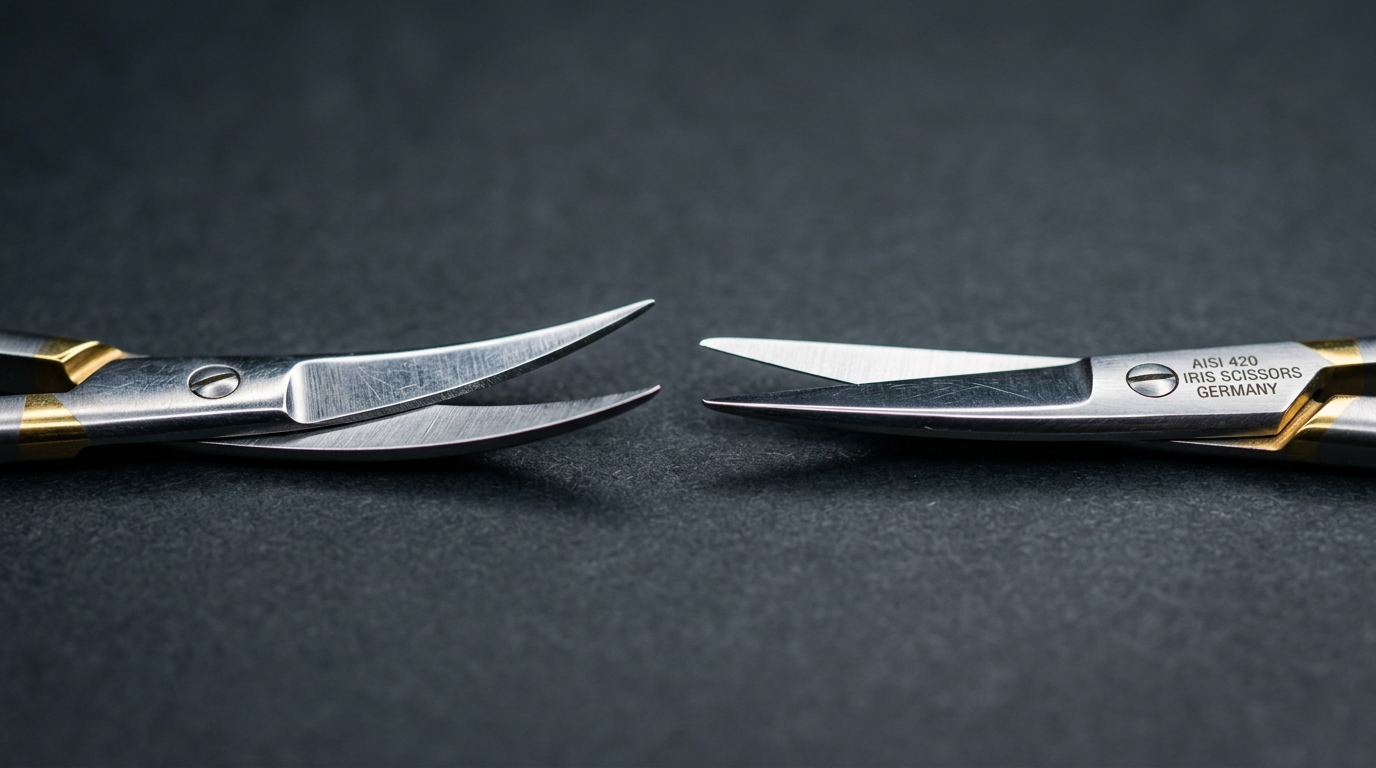
Straight Iris scissors feature blades that run in a direct line with the handles. They are well suited for direct, precise cuts and for trimming fine sutures or delicate tissue in shallow, easily visible fields.
Curved Iris Scissors
Curved Iris scissors feature blades that bend gently to one side. The curve improves working tip visibility and makes it easier to follow small anatomical contours. For a comprehensive comparison of blade shapes, see our technical breakdown of straight vs curved surgical scissors.
Stork-Bill Iris Scissors
Some Iris scissors feature a distinctive bill-like shape resembling a stork beak. This variation offers enhanced angle control for fine, deliberate cutting in restricted anatomical areas.
Other Variations
Iris scissors are manufactured with diverse tip configurations, including sharp/sharp (S/S) or sharp/blunt (S/B), and in delicate or standard patterns. High-performance models incorporate vacuum-brazed tungsten carbide inserts to maintain razor sharpness through repeated use.
| Type | Blade Shape | Typical Clinical Use |
|---|---|---|
| Straight | Straight linear orientation | Precise direct cuts, fine suture removal |
| Curved | Slightly curved to one side | Fine tissue dissection, enhanced tip visibility |
| Stork-Bill | Angled bill-shaped curvature | Controlled micro-cutting in small spaces |
What Are Iris Scissors Used For?
Iris scissors are essential wherever delicate, highly controlled cutting is required. Primary clinical applications include:
- Ophthalmic surgery: Precise sectioning of ocular tissues where micro-accuracy is paramount.
- Plastic and reconstructive surgery: Trimming fine skin flaps and delicate subcutaneous tissue.
- General surgery: Mobilizing fine tissue planes near blood vessels.
- Suture removal and wound care: Sliding fine tips beneath tight surgical stitches.
- Dental and oral procedures: Maneuvering in small, confined intraoral spaces.
- Veterinary and laboratory research: Small-scale tissue dissection and specimen preparation.
Because they are precision instruments, Iris scissors must not be used on dense fascia, wire, or heavy utility materials. Heavy-duty instruments such as Mayo scissors are designed for dense tissue and sutures, whereas longer dissecting shears like Metzenbaum scissors manage deeper tissue separation.
Iris Scissors vs. Other Surgical Scissors
- Iris vs Mayo scissors: Iris scissors are small and fine for micro-work, while Mayo scissors feature heavy blades built for tough fascia and sutures.
- Iris vs Metzenbaum scissors: Metzenbaum scissors feature long shanks for deep cavity dissection, while Iris scissors feature short handles for superficial micro-precision.
What to Consider When Choosing Iris Scissors
- Blade Shape: Select straight blades for linear cuts and suture removal, or curved blades for enhanced tip visibility along tissue contours.
- Tip Profile: Sharp tips deliver maximum precision, while blunt tips protect underlying tissue from accidental puncture.
- Length and Balance: Lightweight 3.5" to 4.5" frames offer maximum fingertip control.
- Material & Metallurgy: Martensitic stainless steel (AISI 420) is standard. Tungsten carbide inserts extend cutting edge lifespan across surgical instrument collections.
- Blade Alignment: Ensure shearing edges meet smoothly along the full length without snagging or binding.
- Surface Finish: High-grade passivated finishes prevent corrosion during repeated hospital sterilization.
- Reusable vs Single-Use: Reusable instruments withstand repeated reprocessing, while single-use options eliminate cleaning overhead.
Tips for Sourcing Iris Scissors
When procuring Iris scissors in volume for hospitals, clinics, or distribution networks, evaluate these manufacturing criteria:
- Quality Systems: Confirm the supplier adheres to ISO 13485 medical device manufacturing management systems.
- Regulatory Compliance: Verify CE marking and FDA documentation for target healthcare markets.
- Material Transparency: Request steel grade specifications (AISI 420/440) and passivation test reports.
- Sample Testing: Evaluate sample batches for blade sharpness, joint alignment, and tactile balance prior to full order placement.
- Catalog Specifications: Confirm length tolerances and pattern consistency listed in the surgical instruments catalog.
Care and Maintenance Protocol
Proper care preserves delicate cutting edges and prevents joint stiffness:
- Clean instruments immediately post-op to prevent dried blood accumulation.
- Submerge scissors in open position during ultrasonic decontamination.
- Store delicate tips in protective silicone sleeves away from heavy tools.
- Follow certified hospital autoclave sterilization care protocols.
- Inspect working tips under magnification regularly for burrs or misalignment.
Final Thoughts
Iris scissors perform a vital role in surgical precision where delicate tissue is involved. Understanding blade variations, clinical applications, and quality benchmarks ensures optimal instrument selection. Usfah Industry manufactures ISO 13485 certified surgical instruments for hospital supply chains and healthcare distributors worldwide.
Frequently Asked Questions
What are Iris scissors used for?
Iris scissors are small, fine-tipped surgical scissors used for delicate cutting and precise tissue dissection in ophthalmic, plastic, dental, and general surgical procedures, as well as fine suture removal.
Why are they called Iris scissors?
The name originates from their initial design for iris and ophthalmic eye surgery, where extremely fine, controlled cutting of fragile ocular tissue was required.
What is the difference between straight and curved Iris scissors?
Straight Iris scissors provide direct, predictable cutting lines ideal for surface cuts and fine suture trimming. Curved Iris scissors feature gently bent blades that improve tip visibility and follow anatomical contours during delicate tissue dissection.
Can Iris scissors cut heavy tissue or surgical wire?
No. Iris scissors are engineered strictly for delicate, fine tissue. Attempting to cut dense muscle fascia, wire, or heavy utility materials will damage and misalign their fine cutting edges. Heavier Mayo scissors should be used for heavy cutting tasks.
How long are standard Iris scissors?
Most Iris scissors range between 3.5 inches to 4.5 inches (9 cm to 11.5 cm) in overall length, providing maximum dexterity and hand control in small surgical fields.