What Are Mayo Scissors Used For?
Discover what Mayo scissors are used for in surgery, including straight vs curved types, Mayo vs Metzenbaum differences, selection criteria, and maintenance.
Mayo scissors are heavy-duty surgical scissors designed to cut dense tissue such as fascia, muscle, and surgical sutures, and the curved version is also used for careful tissue dissection. If you are comparing surgical scissors for operating rooms or clinical procurement, this guide explains the types of Mayo scissors, where each is used, and what to check before choosing a pair.
Whether assembling surgical instrument trays, upgrading hospital equipment, or sourcing tools from a certified surgical instruments manufacturer, selecting the right scissor pattern ensures procedural safety and extends instrument service life. For a broad overview across all operating room shears, compare surgical scissors types and standards.
What Are Mayo Scissors?
Mayo scissors are strong, sturdy surgical scissors with thick blades and blunt tips. They are named after the Mayo Clinic, where surgeons helped popularize the design. Compared with fine dissecting scissors, they are built for force rather than delicacy, which makes them a standard part of general surgical instrument sets worldwide.
Two defining features set Mayo scissors apart:
- Thick, robust blades: Engineered to cut tough anatomical structures and synthetic sutures without blade flexing or edge displacement.
- Blunt, rounded tips: Minimize the risk of accidental puncture or trauma to underlying tissues and blood vessels during surgical maneuvering.
What Are Mayo Scissors Used For?
The primary uses of Mayo scissors in surgery and clinical settings include:
- Cutting heavy tissue: Sectioning dense rectus sheath fascia, thick muscle layers, uterine tissue, and fibrous connective tissue during abdominal, gynecological, and orthopedic procedures.
- Cutting sutures: Straight blades are widely utilized to cut heavy braided sutures, monofilaments, and surgical tubing without dulling finer dissecting shears.
- Tissue dissection: Inserting closed curved blades into dense tissue layers and opening them to separate fascial planes cleanly.
- General operating room cutting: Handling high-force cutting tasks where a strong, dependable surgical scissor is required.
For delicate soft tissue, fine vascular mobilization, or small anatomical structures, surgeons normally choose lighter scissors such as Metzenbaum scissors or Iris micro-scissors instead.
Types of Mayo Scissors
Straight Mayo Scissors
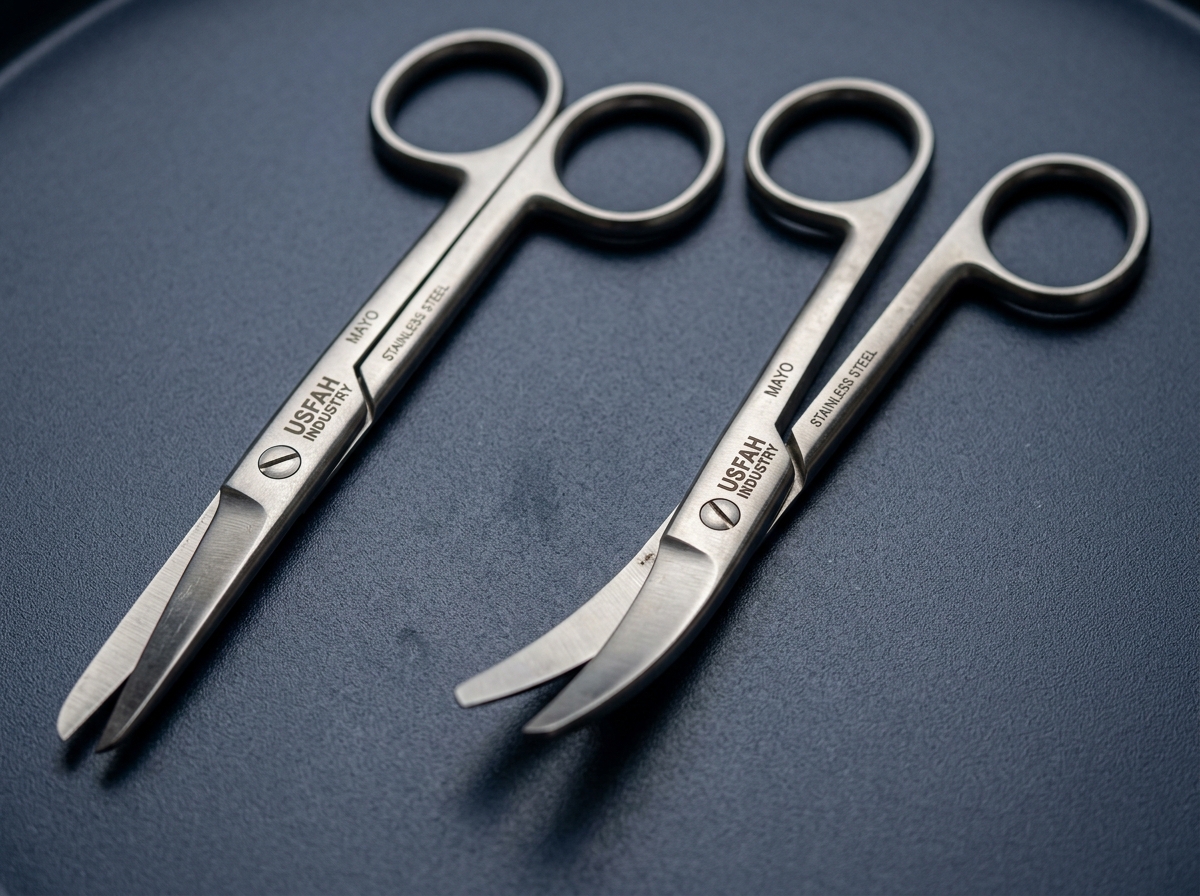
Straight Mayo scissors have blades that run in a direct straight line with the handle shanks. Because the cutting edge is easy to align and control, they are commonly used near the surface to cut sutures, heavy threads, and dense superficial tissue where a direct line of cut is required.
Curved Mayo Scissors
Curved Mayo scissors feature blades that bend gently away from the handle axis. The curvature improves tip visibility for the surgeon and makes it easier to navigate inside deeper body cavities. They are the preferred pattern for cutting and dissecting tough tissue deep within abdominal or thoracic fields.
Straight vs. Curved Mayo Scissors Comparison
| Feature | Straight Mayo Scissors | Curved Mayo Scissors |
|---|---|---|
| Blade Shape | Straight linear orientation | Gently curved away from handles |
| Common Uses | Suture cutting, heavy thread sectioning, superficial dense tissue | Fascial dissection, cutting heavy organ tissue |
| Tip Visibility | Excellent for shallow or surface work | Enhanced visibility in deep body cavities |
| Tip Style | Blunt / Blunt safety points | Blunt / Blunt safety points |
Mayo-Lexer and Other Variations
Some related scissors, such as Mayo-Lexer scissors, feature slightly modified blade curves or narrower shanks for specialized surgical procedures. Manufacturers produce Mayo scissors in standard length ranges, typically from 5.5 inches (14 cm) up to 9 inches (23 cm). Selecting the appropriate length depends directly on procedural depth and required leverage.
Mayo Scissors vs. Metzenbaum Scissors
Healthcare professionals often compare these two essential instruments. Mayo scissors are heavy and built for tough tissue, whereas Metzenbaum scissors have longer, slimmer shanks paired with thin blades engineered for soft tissue dissection.
If the surgical task involves fascia, muscle, or suture trimming, Mayo scissors are the standard choice. If it involves delicate soft organs or vessel dissection, Metzenbaum scissors are preferred. For tissue density matching, compare technical features in Mayo vs Metzenbaum scissors.
How to Choose the Right Mayo Scissors
Before purchasing surgical scissors for hospital inventory or distribution, evaluate these key criteria:
- Blade Shape: Choose straight blades for suture trimming and linear surface cuts, or curved blades for dissection and deep tip visibility.
- Length: Select longer patterns (7" to 9") for deep cavities, or shorter patterns (5.5") for shallow procedural control.
- Material & Metallurgy: Medical-grade AISI 420/440 stainless steel is standard. High-performance scissors feature Tungsten Carbide (TC) inserts (gold handles) across surgical instrument collections.
- Blade Alignment & Action: The shearing edges should close smoothly along the full length without binding, gaps, or snagging.
- Reusable vs. Single-Use: Reusable stainless steel scissors must withstand repeated autoclave cycles, while single-use options eliminate reprocessing overhead.
- Ergonomics: Well-balanced finger rings and comfortable weight distribution minimize surgeon hand fatigue during long operations.
- Manufacturer Quality: Source tools from an established supplier following ISO 13485 and CE standards listed in the surgical instruments catalog.
Care and Maintenance Protocol
Proper care keeps Mayo scissors cutting cleanly and extends their operational lifespan:
- Prompt Post-Op Rinsing: Clean instruments immediately after use so blood and bio-fluids do not dry on the blades or pivot screw.
- Open Position Cleaning: Open scissors fully during ultrasonic or manual cleaning to reach trapped debris in the box joint.
- Autoclave Sterilization: Sterilize according to standard autoclave sterilization care protocols.
- Regular Inspection: Inspect cutting edges regularly and send dull or sprung scissors for professional sharpening.
- Intended Purpose Only: Never use Mayo scissors to cut wire or hard utility items, which causes permanent notch damage to the blades.
Final Thoughts
Mayo scissors are a dependable, general-purpose surgical scissor for cutting tough tissue and sutures, with curved versions adding vital dissection capability. Choosing the right blade shape, length, and material, and maintaining the instrument properly, ensures superior clinical performance and long-term durability. Usfah Industry manufactures ISO 13485 certified surgical instruments for hospitals, clinics, and medical distributors worldwide.
Frequently Asked Questions
What are Mayo scissors used for in surgery?
Mayo scissors are heavy-duty surgical scissors used to cut dense, tough tissue such as muscle fascia and uterine tissue, to cut thick surgical sutures, and, in the curved style, to perform dissection between tissue layers.
What is the difference between straight and curved Mayo scissors?
Straight Mayo scissors feature straight blades ideal for cutting sutures, heavy threads, and superficial direct cuts. Curved Mayo scissors feature gently bent blades that provide enhanced visual line of sight and tip maneuverability when dissecting deeper anatomical cavities.
Are Mayo scissors the same as Metzenbaum scissors?
No. Mayo scissors have thick, heavy-duty blades designed for cutting tough structures and sutures, while Metzenbaum scissors have longer shanks and slender, fine blades designed specifically for delicate soft tissue dissection.
Can Mayo scissors cut sutures?
Yes. Straight Mayo scissors in particular are standard operating room tools for cutting heavy sutures and medical drains without damaging or dulling fine dissecting tools.
What size Mayo scissors should I choose?
Mayo scissors commonly range from 5.5 inches (14 cm) to 9 inches (23 cm). Shorter lengths provide maximum leverage and control in shallow surgical fields, while longer lengths reach deeper body cavities.